

Well before Nikki Fenner joined the ROCIS Low Cost Monitoring Project, she was already aware of the air pollution problems in Southwestern Pennsylvania, where she lives with her husband, two children, and their two cats. Nikki was worried about the impacts that breathing the air on high-pollution days might be having on her family. But she had always thought about pollution as an outside-only problem. She had no idea if she and her loved ones were being exposed to pollution inside their home.
When one of the air quality organizations that she followed posted about a program where she could borrow a set of low-cost monitors for a few weeks and get some readings inside her house, Nikki jumped at the chance. “I thought it would be really interesting to see what we can’t see otherwise in our home,” she said when she sat down for an interview with ROCIS after completing Cohort 65 of the LCMP. She entered the program eager to learn more about the air quality in her home. “When I bought my house initially, we had radon testing done, so I had some experience with knowing that there are things going on that you just can’t see in the air unless you have equipment to monitor it.”

Despite a recent boom in “low cost” monitors on the market (low cost by comparison to research-grade monitors that can cost thousands of dollars per unit), it wasn’t in Nikki’s budget to purchase a whole set of monitors to measure the small particles, carbon dioxide, carbon monoxide, radon, humidity, and temperature in her home. By joining ROCIS, Nikki was not only able to borrow the monitors; she received training from ROCIS staff and personalized feedback about the data that her monitors were recording.
 It turned out that Nikki was right to worry about the contaminants in the air outside, but not entirely in the way she thought. “I realized a lot of our indoor air has to do with how the outside air is doing, because it comes into our home,” Nikki said in our interview. Nikki began to see that indoor air quality was key in protecting her and her family’s health. “We can’t control who’s putting what in the air outside,” Nikki pointed out. “We spend so much time indoors, and that’s where we can control things.”
Outdoor air quality remains important to Nikki. “I check the different apps every day,” she told us, referring to sites like AirNow.gov and PurpleAir. This simple habit can make a big difference if you know what to do with that information. “I think for most people, especially in Pittsburgh, we have houses that aren’t super, like, airtight, so that air outside comes in. So just check on it, and you’ll have a pretty good idea. If it’s bad outside, it’s probably not great inside, so don’t open all of your windows. I like to always have my windows open, but just check the outdoor air.”
Mapping & Tracking Tools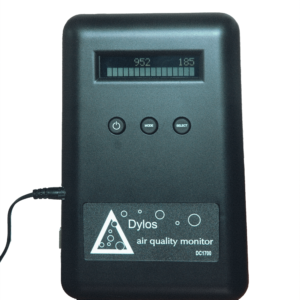 But Nikki only began to see the relationship between indoor and outdoor air once the data started rolling in from her ROCIS monitors. “It was really easy. The feedback was immediate. You can see numbers on the screen in front of you, so it was really fun to see the different testing sites—like, our backyard versus the bedroom versus the living area space. I think that the first night that we set it up, I was making dinner, and it was, like, immediate.”
Unfortunately, the immediate feedback wasn’t entirely reassuring. The numbers on the particle monitor spiked as soon as Nikki started cooking, even though she was in the habit of running her range hood when she was working at the stove. For the first time, Nikki realized that it wasn’t just outdoor sources of pollution that she had to think about. Her own behaviors could impact air quality in the house.
“It was really surprising to see how much of the air [pollution] was because of our own actions,” she explained. “Before starting this, I really [thought] of pollution as, like, factories, something coming from outside. The biggest surprise to me was how much of it was from us in our own homes. Just, you know, like, using candles or melt warmers. We’re all really mindful now of, are we causing problems, you know? What can we adjust?”

Nikki’s family at work in the kitchen
Emotionally, it was hard to see that some of their cherished family rituals were creating pollution in the house. Every week, Nikki and her family have Falafel Fridays and French Toast Sundays, which are a favorite of everyone in the house. But these meals in particular produced some of the highest readings during the monitoring period. “Seeing the numbers was stressful,” Nikki admitted, “but then once we started trying the different things, it actually was fun, because you see the numbers there, you try different things to get them to come down. And when they start coming down, it’s like—it’s amazing, the feeling, knowing that you can do practical things to fix this.”
The interventions that Nikki and her family tried included turning on the range hood earlier in the cooking process, opening the windows if the air outside was good, turning on a DIY fan-filter in the kitchen, switching to cooking oils with a higher smoke point, and experimenting with an induction stovetop, which they borrowed from ROCIS as part of the LCMP. “I didn’t think it was going to be as fun as it was, because I was kind of stressed about how high the numbers were, but once we started [the interventions], it was fun.”
And these little changes made a real difference in the numbers. Nikki’s baseline readings for particles in the house was in the 400 to 500 range (Dylos monitor readings measure 0.5+ µm particles per 1/100 cu ft.), which is considered “fair” in terms of air quality. But when Falafel Friday came around, the numbers peaked at nearly 40,000. French Toast Sunday showed particle readings between 25,000 and 43,000. “Very poor” air quality begins around 3,000. But once they made a few changes, the numbers came way down: less than 4,000 for French Toast Sunday and less than 3,000 for Falafel Friday. In fact, Nikki’s most recent Falafel Friday particle reading peaked at just 164—well within the “good” range.

Now that Cohort 65 is over, Nikki’s whole approach to air quality has changed. “We run the air purifiers pretty consistently now. We weren’t doing that before,” she told us in the interview. “I was only doing it when the air smelled bad [outside], because I didn’t know that it’s coming from inside the house sometimes. We’re more aware of airflow, filtration, what we’re doing in regards to cooking and food preparation. I’m more mindful of [air quality] even when I’m out in the world. In terms of CO2 in my car, just having the window cracked a little bit. It’s hard not to take those things with you once you learn that little things add up.”
A change in awareness of air quality has made a big difference for Nikki and her family. “I want to say, it was really surprising to see how much of an impact there was just by tweaking things. Making small adjustments made huge improvements in the numbers. Probably one of the biggest surprises to me, was just changing how we cook things, using avocado oil when we’re sautéing instead of really good, expensive olive oil. It tastes good, but [you can] add those oils at the end—after cooking—for flavor.”
 Kitchen tips to reduce indoor pollution
Nikki and her family are thinking about purchasing a few monitors of their own to keep the project going and perhaps some additional technical interventions as well such as an induction stovetop or additional filters. But she was quick to note that the improvements started before they spent a penny. “It wasn’t investing in equipment, you know. Opening our windows when the air is better outside. Those are things that are more practical, they’re really easy to do. I was surprised that just doing little things made a huge difference.”
Nikki’s story is just one of hundreds of LCMP participants who have gotten the information they needed to improve the air quality in their homes. Stay up to date on the next LCMP monitoring cohort and other news from ROCIS by joining our mailing list or checking out the LCMP page on our website.