
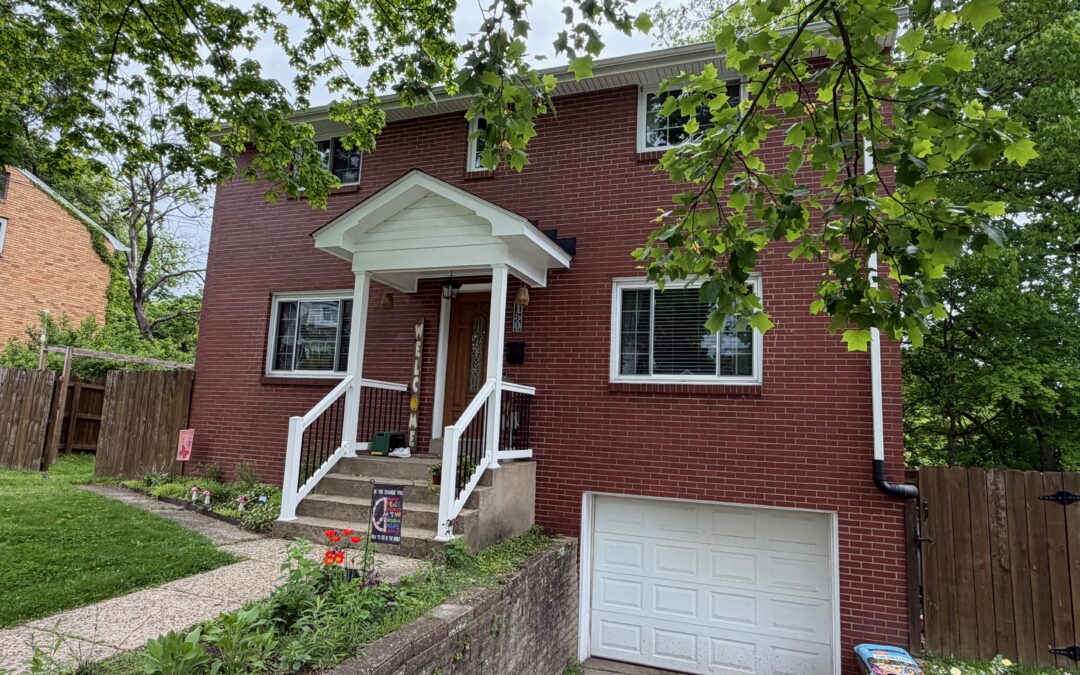
Abbey Keefer was perusing the tables at a community fair when she came across the table for ACCAN (Allegheny County Clean Air Now), a nonprofit that advocates for air quality improvements for communities around Neville Island, which is where Abbey and her family live.
As Aarushi Pant, Executive Director of ACCAN, notes, “Neville Island is just very, very concentrated with a lot of polluters. I think we have twenty-something sources of pollution just within the airshed. Having such a high concentration of facilities that are putting out things like particulate matter, volatile organic compounds—a lot of people complain about smells, about headaches, about symptoms they’re having.”
Abbey, who works in the environmental field, was already aware of the threats of industrial pollution to her family. “When I first started looking at houses in this area,” Abbey told ROCIS when we spoke earlier this month, “I read several articles about cancer in this area, and how the level [is] unusually high.” She signed up for the ACCAN mailing list.
Not long after the community fair, Abbey spotted an announcement in the ACCAN newsletter about an upcoming air monitoring cohort with the ROCIS Low Cost Monitoring Project (LCMP). It was the perfect opportunity to learn more about the air quality issues affecting her family. “I mean, we are raising our kids here, and we have a house here, we have an investment here, essentially. Let’s see how things have maybe changed, or gotten better, and how we are being affected by the problems that are clearly out there.”
Knowing that she wouldn’t be able to manage the time commitment on her own, Abbey asked her husband, Richard Askren, to be the one to attend the online LCMP cohort sessions and send in the monitoring data. He agreed.
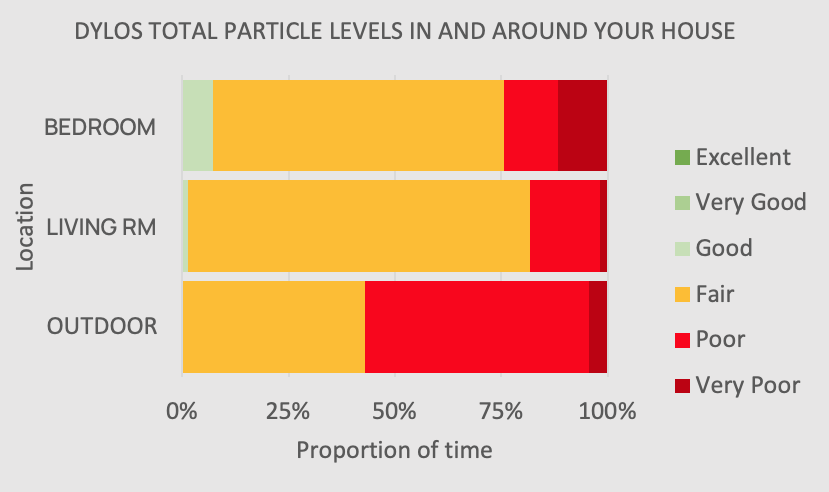
Dylos monitor results for the week ending 9/19/25
Soon enough, results started rolling in from the monitors. “It was worse than I thought,” Abbey said, especially when it came to small particles. The first week of monitoring showed that their indoor particle counts, although better than outdoors, were registering as “Fair,” “Poor,” or “Very Poor” the majority of the time. Clearly, there was room to improve.
Richard and Abbey began experimenting with solutions. They set up a DIY fan-filter (a four-inch MERV filter taped to a box fan) in their living room and ran it continuously. “I think that was somewhat eye-opening,” Richard reflected, “just running that one, simple filter. We saw our particles go from, like, 4,000 in the living room to, like, 200. It was a massive reduction.” They added a second portable air cleaner in the basement.
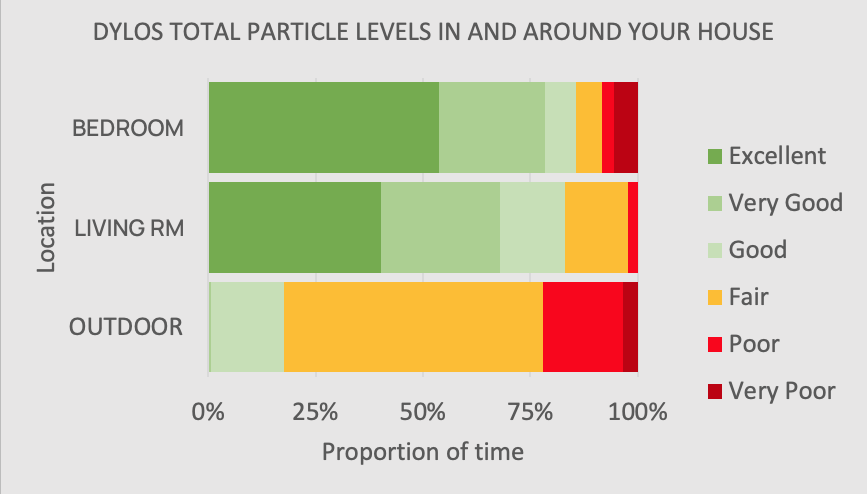
Dylos monitor results for the week ending 10/11/25

As part of the LCMP, Abbey and Richard received a visit from Rhett Major—a.k.a. The Energy Doctor. “Any time I’m doing a ROCIS visit,” Major explained on a call discussing Richard and Abbey’s case, “I’m focused on combustion safety, gas safety, and then filtration effectiveness.” His inspection turned up a few issues with the boiler and water heater in the basement, which were in an enclosed space and required additional ventilation. There were also some leaks in the house—a garage door, an attic door, the fireplace insert, and around the bath fans—that needed attention. But the big surprise was in the attic AC system.
“This is a Pittsburgh house that was not originally air conditioned,” Major noted. “Most of them are not.” Putting an AC system in the attic is a common solution for homes that don’t have sufficient ductwork, such as homes with boilers. Richard and Abbey’s heat pump system appeared to be a relatively new replacement unit, installed by a previous owner.
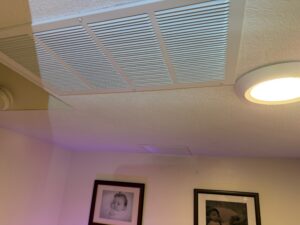
Photo credit: Rhett Major
The only filter in the AC system was mounted in a somewhat inconvenient ceiling grille. “The problem is, it’s only able to accommodate a one-inch filter,” explained Major. “That’s never my best option if I’m designing a system. Deeper, less restrictive filters have a lot more surface area than skinny filters.” With limited surface area, one-inch filters need to be changed more often, and the ceiling location makes that task rather unwieldy.
High-quality filtration for the whole house would be especially important for Richard and Abbey given that outdoor pollution can infiltrate through cracks and gaps or through the AC system itself. Even though their family isn’t currently struggling with pollution-sensitive conditions such as asthma or bronchitis, Abbey was clear that she didn’t want to risk the health impacts—including heart disease or cancer—that come with long-term exposure to airborne contaminants. Luckily, their AC system was already fitted with an efficient ECM motor, capable of handling deeper filters and continuous operation.
Building professionals can use our Air Handler Inquiry to find out what modifications you may need to avoid high energy bills or motor burnout.
But a new filter wouldn’t fix everything. “There were leaks in the duct returns in the attic space,” Major reported. He found more leaks in the supply ducts. Leaks like these are inefficient—raising energy bills by either blowing conditioned air into the attic or drawing unconditioned air into the house. On top of it all, the ducts were poorly insulated. Heat was escaping to the attic in the winter, coolness in the summer. “We’re losing energy,” Richard explained. “We’re losing money by having these leaks in the AC—heating our attic space and thus the entire outside.”
In addition, the unsealed ducts were likely contributing to elevated particle levels in Richard and Abbey’s home. Attics tend to be much more permeable to the outside (and its pollution) than the rest of the house. When the AC system is in operation, leaky attic ducts draw unfiltered air directly into the home . . . and directly into contact with the people living inside.
Unfortunately, it is extremely common for the attic AC units to be improperly sealed and insulated. “It’s an epidemic of leaky ductwork in the attic,” Major told us. “New ductwork in a new build is supposed to be tested if it’s in the attic and pass a standard. But even the standard is 4% leakage. That’s still a lot. However, replacement systems are not requiring that test.” Most likely, Richard and Abbey’s updated attic system had never been inspected for leakage.
1. Check the ductwork for leaks and inadequate insulation.
2. For new installations, visit www.bpi.org/pages/locator/ or www.hersindex.com/find-a-hers-rater/ to find a qualified installer or inspector for your system.
3. Ask your contractor if they can install a 4″- or 5″-deep filter in your air handler.
4. Check to see if your system will operate safely with a higher MERV filter (11 or 13).
5. Read up on why you should avoid placing ducts in an unconditioned attic or how to improve such ducts if you have them.
Seeing that Abbey and Richard were looking at a lot of potentially expensive repairs, we reconnected them with ACCAN, which helps stage indoor air quality interventions for local residents through the Room to Breathe program. Interventions might be as simple as a portable air cleaner, but ACCAN’s Aarushi Pant notes that “sometimes these can be really big projects to improve the air quality inside the home, especially for people that are living close to polluters or who might have pre-existing health conditions, such as asthma and things like that, that might be worsened by having poor air quality inside their homes.” Through the program, ACCAN helps cover the costs of these interventions.
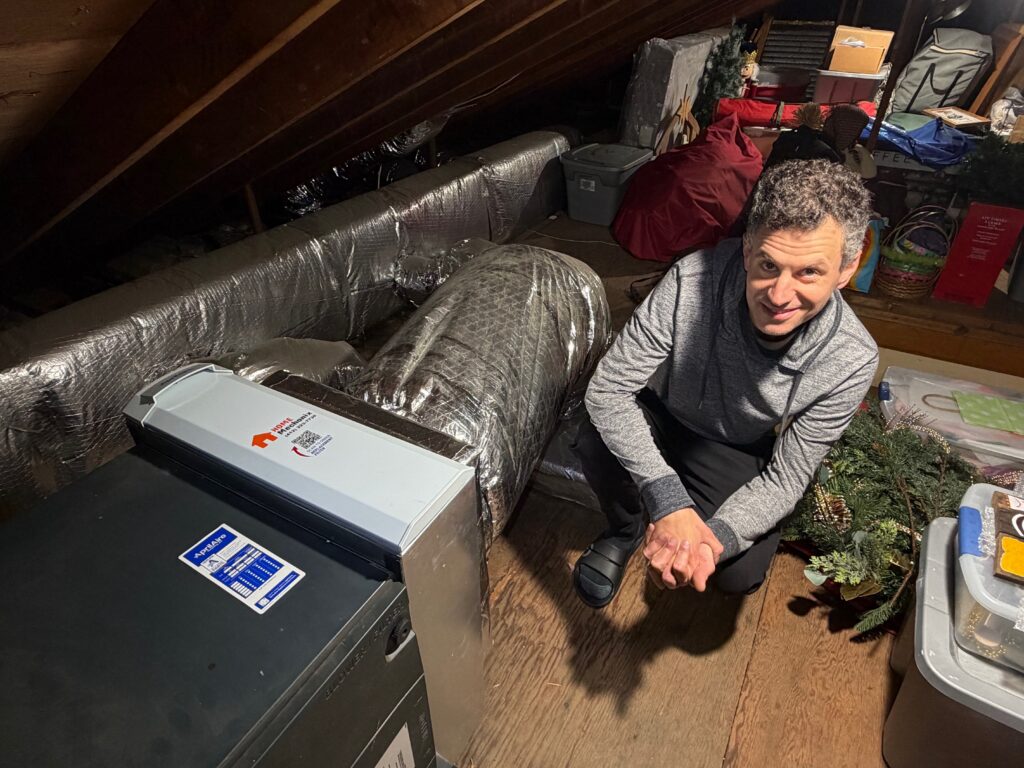
Photo credit: Rhett Major
With ACCAN’s support, Richard and Abbey were able to bring in local contractor Mat Stone of Home Mechanix to seal up the return ducts, attend to the ventilation needs in their basement, and add a more robust filter into the air handler. As a side benefit, the new filter was no longer located in the ceiling, making it much easier to service. With this modification, the air handler could now run continuously on low power as a form of whole-house filtration. As long as Richard or Abbey were able to change the filter every six months or so, they would be in good shape.
When Rhett Major returned to inspect and re-test the system after the work had been done, he found that the air handler was now delivering a nice, gentle supply of clean air to the house. Running the air handler continuously at 35% fan speed would only cost Abbey and Richard about $136 per year, plus the cost of filters.
The improvements to Abbey and Richard’s house have been remarkable, but they aren’t done yet. Richard is going to take what he learned from Mat and Rhett and try his hand at sealing and insulating the supply ducts. At some point, the garage door will need weather stripping. “We’re looking at some improvements to the bathroom fans, too, just to kind of add to what has been done,” Abbey said. Step by step, their house is becoming a true safe haven, capable of protecting the health of the people inside.
Check out this bathroom exhaust fan webinar to learn more.
Abbey and Richard have some advice for other homeowners who are interested in creating a healthy home environment. “Get someone out there to look at your equipment,” Richard said. “That’s going to save you money in the long term, and that hopefully will pay for itself one day. It’s a really important investment, I think. In your health. It’s an investment in helping to optimize your energy consumption and keep your energy bills down, and to me, at this point, those things are a no-brainer.”
“We’re very grateful that we were in this program,” Richard reflected at the end of our conversation. “The knowledge and support that we’ve gotten from ROCIS and ACCAN has been massive. I’m just very, very grateful.”
Visit the LCMP pageThank you to Abbey and Richard for participating in the Low Cost Monitoring Project and for sharing your story. Thanks to Rhett Major and Aarushi Pant (and everyone at ACCAN) for your expertise and support as we work together to improve indoor air quality in the region.